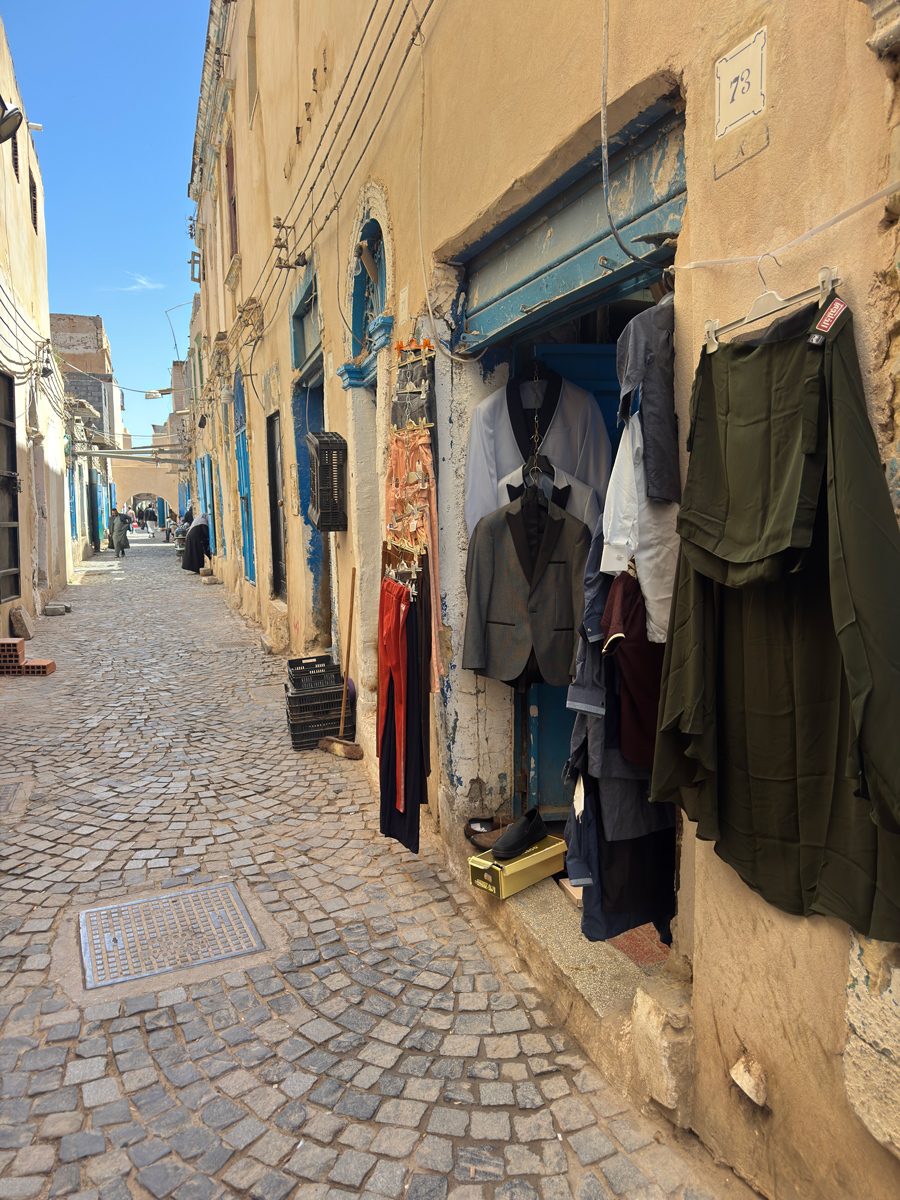
It is difficult to determine exactly where the dust of the Medina ends and the air of the shop begins. Outside, in the narrow, shadowed arteries winding away from Souk al-Turk, the atmosphere is a heavy, coastal suspension. The dense humidity of the Mediterranean clings to the abrasive, microscopic red silt blown in from the south by the ghibli wind, mixing with the scent of bakeries, the exhaust of idling delivery scooters, and the faint, briny damp of the sea walls. But just inside this narrow, uneven doorway, the dust loses its bite. It dances lazily in a single, thick shaft of mid-afternoon sunlight, settling over everything like a soft, quiet blanket—a powdery, golden trajectory finally taking a rest.
I stand just inside the threshold, watching the cobbler. He is half-obscured by a pale blue haze, a cozy, atmospheric mixture of the cigarette miraculously and permanently balanced on his lower lip, and the sharp, dizzying perfume of toluene evaporating from open, dented tins of neoprene cement. The shop smells of this potent, dreaming cocktail. It is the sweet, intoxicating, chemical hope of second chances mixed with the softer, deeply familiar odors of cured goat hide, beeswax, and old, compacted sweat.
He is an older man, his hands stained a localized, permanent burnt rubber around the cuticles and knuckles, the skin mapping its own topography of calluses. He moves with the patient, unhurried grace of someone who has spent a lifetime brokering compromises between impossible, stubborn materials. He doesn't seem to mind my presence; in the thick, warm air of the shop, I am just another quiet object finding a place to stand, posing only a faint demand.
He presses the heel of a battered, heavy work boot against the spinning abrasive belt. The machine hums—a low, throaty purr that vibrates through the floorboards—gently scuffing away the microscopic layer of foreign asphalt the shoe had collected. He is preparing a fresh, rough, porous surface for the glue. It is a tender sort of erasure, taking away the memory of the road to save the shoe. He switches off the machine, and the sudden silence makes the sounds of the souk outside—the distant rattle of a blue wheelbarrow over the limestone paving, the musical cadence of a vendor selling foreign currency—feel delightfully far away. It is as if this room is operating on a completely different geological clock.
He takes a long, thoughtful drag from his cigarette, the ash defying gravity. “You can't rush them,” he murmurs, his voice a gravelly warmth. He is looking at the sanded boot and the viscous amber adhesive with the weary, forgiving affection of a parent. “If you put them together while the glue is wet, they can’t breathe. The bond suffocates. The glue has to sit there, open to the air, and almost completely forget it was ever a liquid before it can hold on for good.”
In the drowsy, sun-warmed air of the workshop, as the solvent fumes weave happily through the cigarette smoke, the certainties of who is mastering what begin to softly fray at the edges. The ambient pressure of the room seems to weigh equally on the lung and the leather. The boundaries soften. It becomes woefully hard to keep the histories straight.
Some of what sits on the workbench was coaxed up from deep, ancient sedimentary slumbers. They are pumped across blinding, silent expanses of the Fezzan in hot iron pipes, subjected to extreme heat and sulfur, and cooked into vulcanized resilience just to give a heel a bit of bounce against the earth. Other parts were borrowed from the flanks of animals. They are severed from the muscle, steeped in vats of heavy, bitter tannins and alum, and stretched tight over wooden lasts until they forget the feeling of the grass entirely and learn the rigid, unyielding shape of a city street.
And then, they arrive to meet them in the dark.
The foot, the body, the traveler—they too are drawn across blinding expanses, subjected to the heat of the road, molded by the pressures of the borders. When the bone finally meets the stiffened hide, a quiet, almost tender negotiation of deformities begins. It becomes difficult to say who is accommodating whom. Does the living, pulsing marrow dictate the stride, or does the opinionated hide gently, persistently talk the skeleton into a new kind of limp? To slip into that unlit interior is to join a very crowded, overlapping conversation. The wearer becomes part of the polyurethane’s daydream, a biological engine happily feeding the friction against the limestone, yielding seamlessly to the quirks, the collapsed arches, and the bunions left by strangers. It is a slow, mutual compromise, a companionable wearing down in the dark.
And when the warmth finally slips out, wandering off into the bright, chaotic noise of the alleys, the space left behind refuses to act empty. They retreat, yet they somehow stay right there, stubbornly lounging in the crystallized salts of the insole and the deep, habitual smile lines creasing the vamp. Staring into the hollow of the shoe, the thread of who is where completely unravels. Did the flesh continue the journey out there in the Medina, or did the sheer, exhausting effort of the day decide to stay behind, taking a nap in the hide that still braces itself to support a phantom weight? The fatigue loses its owner, floating happily in the chemical haze. The unlit cavity holds onto the precise, structural memory of a shifting mass. It rests on the workbench not as a void, but as a petrified verb. The materials have absorbed the human comedy so thoroughly that the emptiness itself feels sociable, acquiring a dense, undeniable volume. It stands upright in the fumes, maintaining the exact, slightly crooked posture of the one who simply stepped out of the frame.
Behind the cobbler, rising into the shadows of the vaulted ceiling, is a sagging wooden shelf coated in a thick layer of that ambiguous, gentle grit. A row of finished repairs sits there, a quiet congregation perfectly aligned.
“They have been resting up there a long time,” I say, smiling a little at the lineup.
He taps his cigarette against the edge of his workbench, the ash finally falling onto a pile of colorful leather scraps. “Months. Some a year. They bring them in, they haggle over a scrap of rubber, and they say they will absolutely return on Tuesday.” He pauses, picking up a small, stiff brush to test the tackiness of the glue. “Tuesday is a very tricky geography. The city distracts them. Or the sea calls. Or perhaps they just find they like walking barefoot.”
I step closer to the shelf. These are mostly heavy, enclosed shoes—stout sneakers with frayed, knotted laces, hiking boots stained with dry mud from unknown provinces, steel-toed shells scuffed to the grey metal. They look like tired travelers wrapped in thick coats, designed to insulate the foot from the vastness of the earth, to conquer distance through sheer, sealed endurance. I look at the dark, polished indentations pressed into their cork insoles, trying to imagine the eccentricities of the phantoms who left them. They refuse to give up their secrets, offering only the silent lingering traces of their erosion.
Then, my eyes catch a lonely anomaly at the far end of the shelf. It sits slightly apart from the heavy boots: a simple, worn leather balga. A slip-on sandal with a flat, rigid sole and an entirely open back. The leather is dyed a faded mustard yellow, stained a rich, dark brown at the edges from the oils of human skin.
The cobbler, following my gaze, reaches up with a glue-stained hand, brings the balga down, and places it gently on the counter.
“Ah, this one,” he says, tracing a thick, clumsy, but incredibly determined line of white thread anchored deep into the sole. “When you wear a shoe with no heel, the foot has to fight to keep it on. All the stress of the body is pulled through this one strap. Eventually, the leather just asks for a break.”
I stare at the brave white thread piercing the mustard leather. To look at the balga is to look at a fundamentally different, far more anxious relationship with the ground. Unlike the boots, which swallow the foot whole and ask for nothing once the laces are tied, the balga requires constant, waking attention. In Arabic, the word for foot is qadam (قدم). From these exact same three root letters, we pull the word taqaddum (تقدم)—to advance, to make progress, to step bravely forward into the future. Yet, beautifully and terribly, this exact same root also gives us qadim (قديم)—the ancient, the old, the past that is already gone.
It is the physical architecture of hesitation. It brings to mind the Blanchotian step—le pas. The French word holds a lovely, dizzying ambiguity, meaning both the forward act of stepping and the absolute negation of it (“not”). The step is always shadowed by its own impossibility. The language itself understands the paradox of the balga.
To take a step forward (taqaddum) using the foot (qadam) is simultaneously, grammatically, a tether to antiquity (qadim). Every step is a historical haunting. The balga makes you physically feel this root in your muscles. Because the heel is unmoored, taking a step is not a confident, linear march; it is a stutter, a little dance of compromises. The toes must subconsciously clench, clawing playfully downward into the leather; the arch must maintain a rigid, waking tension to prevent the heavy sole from slapping the limestone and staying there. You are trying to move into the future, but the open heel constantly threatens to drop you right back into the dust of the past.
Every forward movement is an act of willful affection for the object, a desperate, continuous attempt to keep the qadam and the qadim moving together. You do not simply walk in a balga; you manage the condition of almost losing it, a continuous, low-level flirtation with letting go entirely.
And the open back is wonderfully porous. It refuses the hermetic seal of the transit boots. It invites the whole world in. The ghibli sand, the radiating, baked warmth of the Medina stones, the salty air—they mix freely with the bare skin of the heel. The foot is forced into a vulnerable, inescapable romance with the environment.
I lean closer, inspecting the dark, smooth crater in the yellow leather where the stranger’s heel once rested. It is incredibly deep, a polished bowl of compressed fibers, while the toe box is almost untouched. This was not the wear and tear of a long, grueling march across borders. This was the wear of a long, heavy wait.
It is a strange, melancholy thing to realize that waiting leaves a physical dent in the world. I imagine the absent wearer shifting their weight from one leg to the other in a shadowed doorway near the souk, feeling the sun move inch by inch across the whitewashed wall, anchored entirely to the pavement. The balga is a shoe designed for the threshold, meant to be slipped off with a sigh of relief when entering a room or a mosque. But here, the threshold had become the whole world. The waiting had become the entirety of the journey.
They had left it here in this drowsy, chemical warmth, asking the cobbler to work his magic so the shoe could hold together just a little longer. They needed the white thread to endure the sheer, exhausting effort of standing still.
But the pause must have finally broken. The wait ended, and they danced off into the city before Tuesday ever arrived.
The cobbler sets his cigarette down on the edge of an ashtray. The neoprene cement has lost its gloss; the solvent has floated away to join the dust in the sunbeam. The glue is ready. He aligns the new rubber sole with the sanded leather of the heavy boot and presses them together. Then, with sudden, immense force, he strikes the bottom with a heavy iron hammer.
The sound is sharp, definitive, and deeply satisfying. Two distinct materials, separated by millions of years of geological time and thousands of miles of human trade, are suddenly and happily merged.
On the counter, the balga sits silently. The white thread holds the yellow leather tight to the sole in a fierce, perfect embrace. It is a fully functional little machine, perfectly repaired, patiently waiting to exert its gentle demands on a body that has already slipped quietly out of the frame, leaving only the polished, smiling shape of its absence behind.